
Complete Guide to Buying and Selling Property Taxes in Nepal
By Square Estates · Last updated
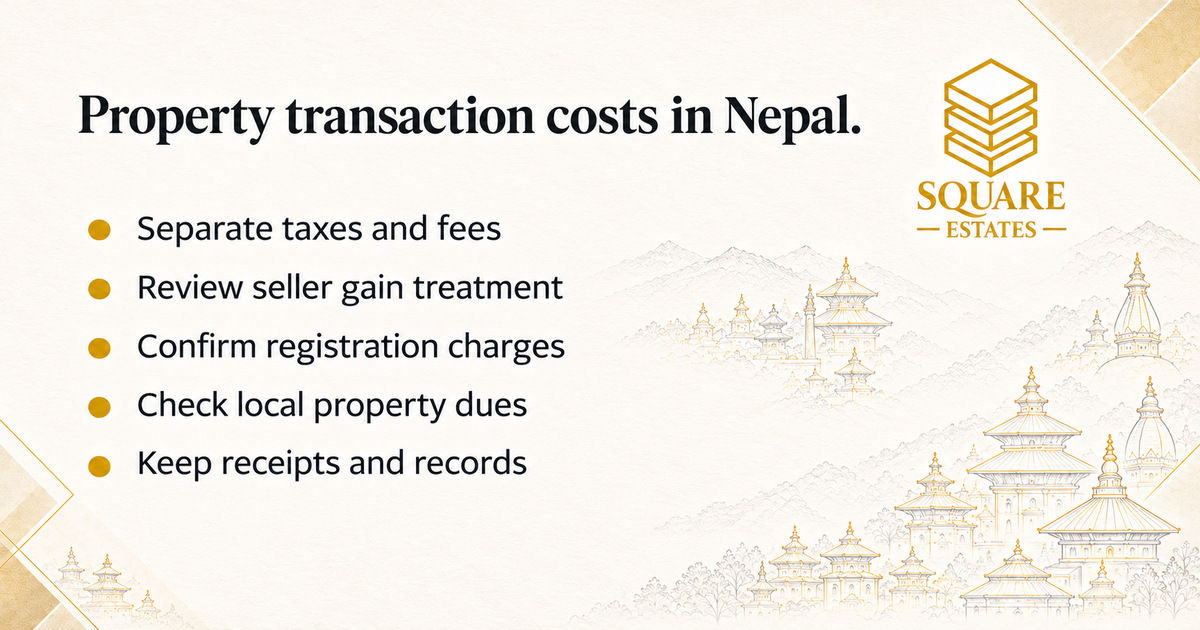
A practical guide to separating seller gain-related tax, registration charges, local dues and professional costs in a Nepal property transaction.
Before agreeing the final price of a Nepal property, buyers and sellers should work out the costs on each side. Registration charges, possible tax on the seller's disposal, local dues and professional fees have different bases and may be payable to different parties. An itemised estimate will show what still needs confirmation.
For Kathmandu Valley property, start by identifying the municipality, ward and responsible Malpot, or Land Revenue Office. The applicable fiscal year, valuation, ownership history and the parties' circumstances all need examination. The following guide explains what to prepare for a discussion with a Nepal-qualified tax adviser and the relevant offices; it does not calculate a property's tax bill.
Separate the costs before agreeing who pays
Registration charges arise in connection with the formal transfer. Tax on a seller's gain concerns a different question: whether and how the disposal is taxed under income-tax rules. Local property dues may concern a period before the sale. A lawyer's bill or an agreed agency fee is a professional or service cost, not the same item as a government tax.
Ask for each line to show the amount, its basis and the person responsible. The contract can record commercial arrangements between buyer and seller, but an agreement between the parties does not by itself settle who owes a payment under the applicable law.
For a first discussion, prepare a working list:
- The intended purchase price and the parcel details.
- The seller's acquisition documents, dates and cost evidence.
- Current ward or municipal tax receipts and any unpaid amounts.
- The proposed transfer date and the offices handling registration.
- Any claimed concession and the evidence supporting eligibility.
What a seller should discuss about capital gains
The Inland Revenue Department distinguishes between gains from non-business property and property used in a business in its property-transaction guidance. The correct treatment depends on the seller and the asset. A seller who acquired a house for personal use should not assume that the same calculation applies to a company's business asset, inherited property or a different type of disposal.
For an individual sale, assemble the acquisition deed, evidence of the acquisition cost and records of expenditure relevant to the property. A tax adviser can determine which amounts current law permits, how to calculate any gain and whether advance tax or another obligation applies. A renovation receipt is not automatically a deductible cost.
Ownership dates can affect the applicable treatment. They need documentary support, particularly where a property changed hands through inheritance, a gift or a division of ownership. The relevant date and basis should be established for the actual transaction, not copied from a neighbour's calculation.
The department's online explanations and older translated materials can show different rates or refer to different versions of legislation. Verify the current Income Tax Act, the current federal economic act and any applicable notices with the adviser before using a rate. A gain may be taxable even when the parties agree to call a payment something else; let the adviser review the real transaction and documents.
Registration charges: a buyer's budget item
The rajinama is the sale deed used to transfer the property. Before the parties register it, obtain an assessment of the applicable registration charges from the responsible Malpot. The buyer should budget for the charge and agree the practical payment arrangements with the seller and advisers, while confirming the legal liability in the particular case.
Kathmandu and Lalitpur are in Bagmati Province. The provincial finance ministry maintains an economic acts listing, including the 2083 act. Ask the office which fiscal-year schedule, subsequent notices, valuation and classifications apply to the exact property. The sale price in the deed and the valuation used for a charge may require separate examination; obtain the office's written calculation rather than assuming the base.
A concession or reduced charge should enter the budget only after eligibility, documents and the current rule have been confirmed. Do not rely on a rate from an earlier fiscal year or a general online table for a different municipality.
Local dues and the ward
Request the seller's latest municipal or ward tax receipts and ask the local office what remains payable for the property. The records needed and the way local dues are assessed depend on the municipality and the property's particulars. A local tax receipt is useful evidence for the transfer file, but it does not by itself establish ownership or the absence of a registration restriction.
If there are arrears, agree who will settle them and when, then keep the official receipt with the transaction documents. The written purchase terms should also deal with any balance discovered before handover. An informal promise that dues have been paid is difficult to reconcile later without a record.
For Lalitpur Metropolitan City, begin with the relevant ward and metropolitan revenue office. A property elsewhere in Lalitpur district may fall under a different municipality; confirm that jurisdiction before using a form or local rate.
Costs that are not tax
Survey, legal, valuation, lender and agency costs may be relevant to the purchase. Some are payable to private professionals or institutions and should be shown separately from official charges. Ask each provider for the scope of work, fee and any conditions that could change it. If a lender is involved, include its documented charges and the cost of meeting its conditions in the budget.
A proposed allocation might put registration charges in the buyer's working budget and the seller's potential gain-related tax in the seller's working budget. Treat that as a starting point for discussion, not a universal legal allocation. Have each party's adviser identify the actual liability and put any agreed payment or reimbursement terms in the sale documents.
Before the registration date
Request a final, itemised statement and compare it with the deed and the parties' agreement. Resolve any discrepancy in the seller's identity, acquisition history or tax records before treating the estimate as final. If the transaction includes a loan or a restriction requiring release, coordinate the timing of payments and official steps with the lender and lawyer.
Keep copies of the assessment, declarations where applicable, payment receipts and the registered deed. Confirm which office will update the ownership record and whether any local records need a separate follow-up. For the broader purchase sequence, Square Estates' buyer's guide covers the decisions before registration.
Before releasing funds, have the responsible offices and your tax adviser confirm the estimate, any claimed concession and the payment responsibilities for this transaction.
Square Estates
Ready to take the next step?
Our team knows the Kathmandu Valley property market. Book a free consultation.
Book a consultation