
Complete NRN Guide to Buying, Owning, and Selling Real Estate in Nepal
By Square Estates · Last updated
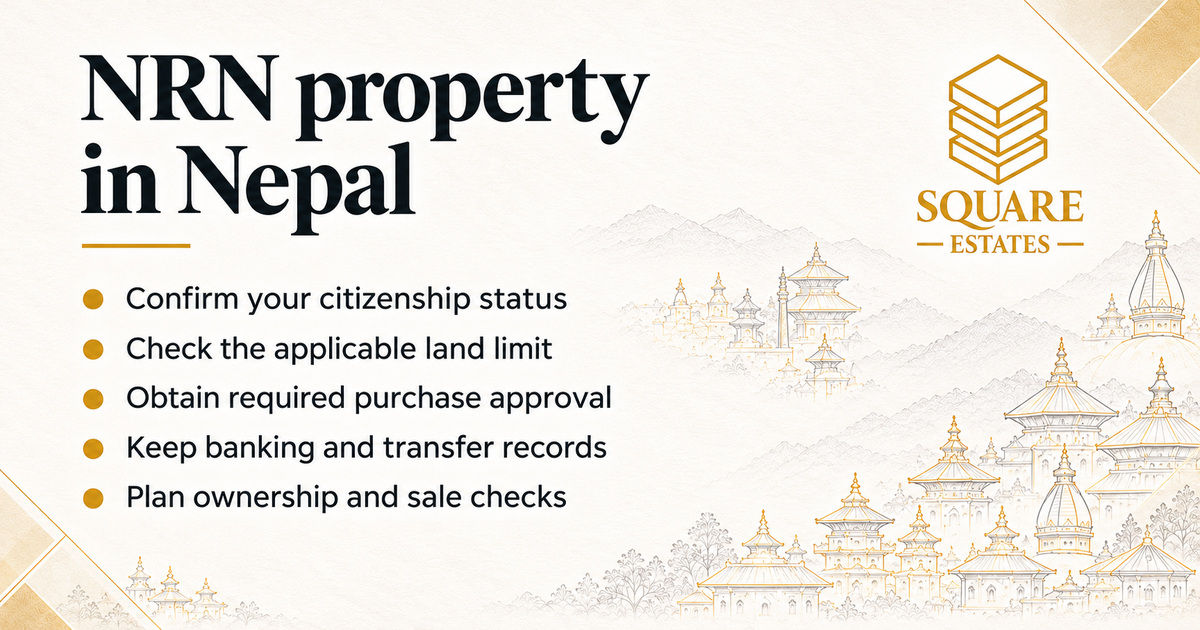
An NRN property purchase starts with the buyer's legal status. Review the published residential framework, approval file and ownership records before committing funds.
Before an NRN buyer pays bayana, the advance agreed with a seller, the buyer needs to establish which legal route applies to their documents. Someone who remains a Nepali citizen, a foreign citizen of Nepali origin with an NRN identity card, and a holder of NRN citizenship should not be treated as the same case.
For a Kathmandu Valley home purchase, confirm your legal status before paying an advance. A Nepal-qualified lawyer should review your documents and the proposed property, including the current law and office directions that apply to the transaction.
Establish your status before choosing a parcel
The Ministry of Foreign Affairs' NRN guidance distinguishes foreign citizens of Nepali origin from Nepali citizens residing abroad. Eligibility definitions have conditions, including exclusions involving SAARC countries. Living overseas or having family roots in Nepal is not, by itself, a complete property-purchase instruction.
An NRN identity card and NRN citizenship are different documents. Section 7A of the Citizenship Act provides a route to NRN citizenship for qualifying foreign citizens with the specified former Nepali citizenship connection, for economic, social and cultural rights. It does not turn every person described informally as an NRN into a holder of that citizenship.
Put your current passport, citizenship documents and any NRN card or NRN citizenship certificate in one file. Include evidence of name changes and any former Nepali citizenship documents. A relative's experience at a different office may involve a different status. Your adviser should identify the route that fits your own record, including any current directions applying to NRN citizenship holders.
Understand the residential purchase framework
Section 10 of the Non-Resident Nepali Act permits a foreign citizen of Nepali origin to purchase prescribed property for residence for themselves or their family, subject to the prescribed conditions and area. It also provides for sale of property purchased under that provision, subject to prevailing law.
The residential purpose matters. Permission for a family home should not be read as a general authorisation to trade in land or run a property business. A proposed rental investment, commercial use or development needs its own legal assessment.
The NRN Rules, rule 11, set out these area ceilings for the residential route, in any one of the specified areas. The linked government copy incorporates amendments through the end of Jestha 2082; confirm any later change and its application before relying on it for a purchase:
- Kathmandu Valley: up to two ropani.
- Municipal areas in Tarai districts: up to eight kattha.
- Municipal areas in other districts outside those categories: up to four ropani.
- Other Tarai areas identified in the rule: up to one bigha.
- Remaining areas outside the preceding categories: up to ten ropani.
For Kathmandu and Lalitpur buyers, the Valley provision is the relevant starting point. These figures are not separate allowances to add together. The rules' historical local-government terminology also needs to be matched to the present location of the parcel.
Rule 11(2) separately addresses property acquired while the person was a Nepali citizen. Disclose existing holdings to your lawyer before assuming that a new purchase fits the framework. Likewise, do not assume that an NRN citizenship certificate automatically removes every restriction or that the identity-card procedure applies unchanged to it. Obtain case-specific confirmation of the applicable route and area.
Prepare the approval file before committing funds
For the rules-based residential purchase route, rule 11 describes an application to the Foreign Affairs Secretary identifying the location, area and agreed price, followed by approval before registration.
The Ministry's published property-purchase checklist includes the NRN card, foreign citizenship and passport copies, the seller's identity, Lalpurja, survey or trace-map information and current land-revenue receipts. For a house, it also lists building-related records. Lalpurja is the land ownership certificate; it is one part of the file, not a substitute for checking the parcel and seller's authority.
Before arranging travel, obtain the current office checklist for your status and property. It should establish which originals, copies and representative documents to bring. For NRN citizenship, the office also needs to confirm the route it will use for approval and registration. Allow for that confirmation when agreeing a completion date.
A bayana agreement should allow time for the necessary approvals and property checks. Have your lawyer set out what happens to the advance if a required approval is refused or the agreed conditions cannot be met. Avoid relying on a verbal assurance that the paperwork will be sorted out after payment.
Check the home as well as the eligibility
A buyer's eligibility does not establish that the property is suitable to buy. Compare the kitta, or parcel number, across the records and the land being shown. Have the appropriate professionals review ownership, restrictions, boundaries and legal access through the relevant Malpot, or land revenue office, and survey records.
For a house, arrange an independent engineering assessment and check the available municipal approvals and completion records for that exact authority. Record alterations, shared facilities and any unresolved questions. A property described as being in Lalitpur may fall under a different municipality from Lalitpur Metropolitan City.
The Square Estates buyer's guide can help organise the wider purchase discussion. Use professional findings and office records for legal and technical conclusions.
Plan the money trail before transfer
Ask your bank which account and payment route are appropriate for the purchase, what source-of-funds evidence it needs and what records to retain. Keep the remittance advice, exchange records, payment receipts and registered transaction documents together.
A future sale and a future transfer of proceeds abroad are separate questions. Before relying on an exit plan, obtain advice on the applicable foreign-exchange route and approvals. Nepal Rastra Bank's Foreign Exchange Management Department publishes the relevant circulars and amendments; a general investment repatriation statement should not be treated as clearance for a particular home sale.
Build a transaction budget with current charges confirmed for the case, professional fees and any financing costs. There is no reliable universal fee percentage for every NRN buyer and property. The applicable fiscal year, province and transaction details need to be checked before a payment schedule is fixed.
Keep ownership and a later sale documented
At completion, have the lawyer and responsible office coordinate the approved transfer and the ownership-record updates required for the transaction. Check the issued records for the correct names, parcel details and area. Keep the approvals and bank evidence with the registered deed and possession-handover record.
While you own the property, maintain the documents and arrangements needed for its actual use. An owner abroad should establish who can receive notices, arrange maintenance and obtain professional advice when required. A representative's authority should cover the task they will actually perform.
When selling, bring the original acquisition approval, ownership history and banking records to your adviser early. Recheck your current status, signing authority, taxes and the proposed treatment of the proceeds. If you cannot attend, confirm the form of authority the offices will accept before authorising someone to act.
Before agreeing a purchase or sale date, put the remaining decisions in writing: the office's confirmation of your route, the property's outstanding checks and the bank's requirements for the payment. Resolve those items with the professionals handling the transaction.
Square Estates
Ready to take the next step?
Our team knows the Kathmandu Valley property market. Book a free consultation.
Book a consultation