
Step-by-Step Government Process to Complete a Property Purchase in Nepal
By Square Estates · Last updated
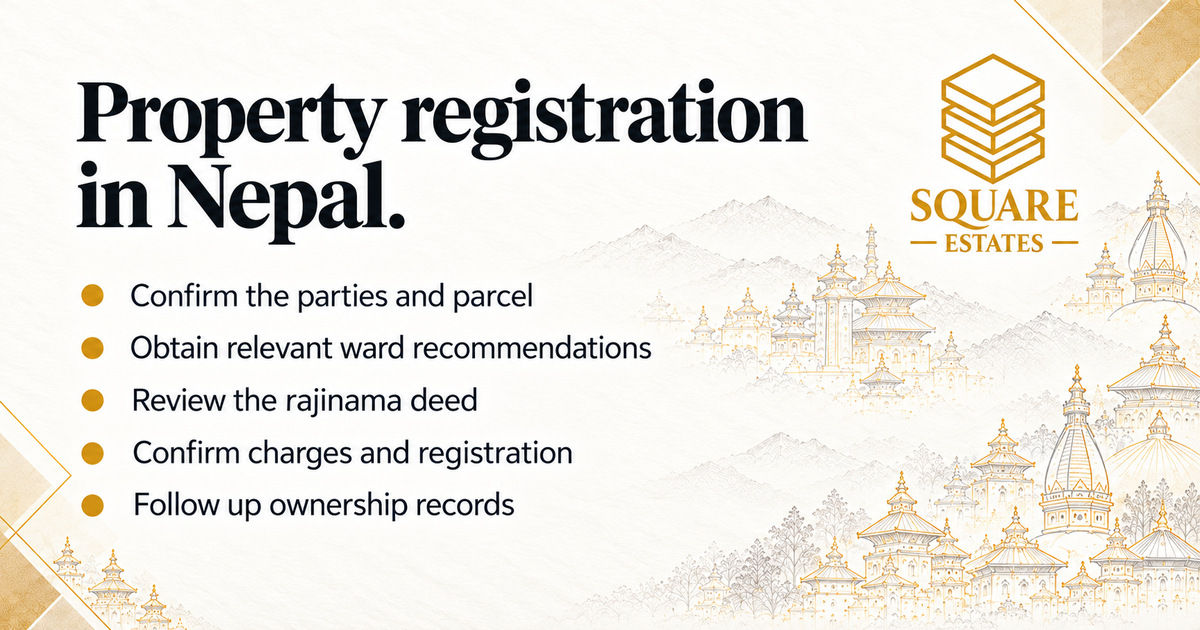
Follow the key steps in a Nepal property transfer, from ward documents and the sale deed to Malpot registration and ownership-record updates.
After agreeing to buy a property in Nepal, you will need a sale deed, an assessment of the applicable charges and registration at the responsible office. The documents and sequence depend on the property and the offices handling the case.
For a house or plot in Kathmandu Valley, identify the municipality, ward and land revenue office before setting a registration date. A locally qualified lawyer can coordinate the deed and advise on unresolved ownership or restriction issues. The buyer, seller, lender and officials may each need to complete different steps.
Start with the property and the parties
The Lalpurja, or land ownership certificate, gives you a starting point for the parcel and recorded owner. Compare its details with the seller's identity and the property being purchased. A kitta is the individual parcel number; its area and location should correspond to the records and the site.
Before preparing a transfer, your lawyer should establish who has authority to sign and whether co-owners, inheritance or a representative's authority need attention. Ask the responsible Malpot, or Land Revenue Office, what current records and documents are required for this transaction. An ownership certificate alone does not establish that every restriction has been cleared.
A baina, also written bayana, is the advance agreed toward a purchase. Before paying it, have the proposed agreement reviewed. It should explain the property, payment, deadlines and what happens if a material check or financing condition fails. Agree the consequences for this transaction; do not assume an advertised percentage or a verbal refund promise will govern your case.
Obtain the relevant ward recommendations
The local ward may be involved in confirming facts used in the transfer. Two terms a buyer may encounter are ghar bato sifaris, a house-and-road recommendation, and Char Killa, the four boundaries. Confirm with the relevant ward and Malpot whether each document is required, what information it must contain and who must apply.
Compare a house-and-road recommendation with the parcel and other records. A recommendation alone does not establish a legal right of access or resolve a boundary dispute. If the property is in Lalitpur Metropolitan City, start with that municipality and the correct ward; a requirement from another municipality or land office should not automatically be treated as applicable.
The Survey Department's Mero Kitta service describes services including map and plot-register prints. Its application requirements include ownership documents. Your surveyor can advise which map or field records are useful and whether a site demarcation is needed before the parties proceed.
Prepare and review the sale deed
The rajinama is the sale deed used for a transfer. Have a qualified practitioner prepare or review the likhat, the written instrument, against the agreed transaction and the requirements of the responsible office. Compare the parties' names, the kitta, area, price and any other particulars with the underlying records.
Identify restrictions, such as a rokka, before fixing the payment sequence. If a lender or another authority must issue a fukuwa, or release, coordinate that step with your lawyer and the relevant institution. Decide what evidence will establish that the restriction has been released and when the remaining purchase money will be paid.
A lender's involvement may add document and timing conditions. Obtain those conditions in writing and reconcile them with the deed, the release of any existing restriction and the proposed registration date.
Confirm valuation and current charges
Before arranging the balance, request an itemised calculation for the specific transaction. Identify the assessment basis, government charges, any applicable tax, professional fees and who will pay each amount. Keep sufficient funds for the amounts confirmed by the relevant office, rather than relying on an old online rate.
Bagmati Province publishes its economic acts. The current fiscal-year law, applicable notices, valuation and transaction details must be checked with the responsible office and your adviser. A rate or concession that applies to one buyer or parcel should not be assumed to apply to another.
Where the office requests tax receipts, recommendations or other supporting documents, check that their details agree with the deed. Local requirements may differ, and a missing or inconsistent record can prevent the office from completing its review as planned.
Complete likhat parit at Malpot
Likhat parit is the formal registration of the written instrument. Nepal's Civil Code requires registration of an instrument transferring immovable property. A baina agreement or payment of an advance is a separate step and does not by itself complete that registered transfer.
The parties should confirm the appointment, originals, representation documents and payment arrangements with the relevant office. The office's identity verification and digital procedures may include biometric capture; confirm what is required there instead of assuming the same sequence applies at every Malpot. Review the particulars before signing and retain official receipts.
Coordinate the release of the balance with the lawyer and, if relevant, the lender. A plan for who pays whom and what evidence is needed before funds move is especially important when an existing restriction must first be released.
Follow through on ownership records
After registration, confirm the associated ownership-record update. Section 471 of the Civil Code addresses dakhil, kharej and namsari where required following a registered deed. Namsari is not a term reserved only for inheritance; the procedure and records to be updated depend on the transaction.
Ask the responsible office what evidence of the update and buyer's ownership certificate will be issued, and check the particulars when received. If another office must update a related record, establish who will follow up. Do not assume that receiving a deed or paying an advance proves every later administrative step is complete.
Keep the registered deed, receipts, ownership documents and release evidence together. A separate written handover can record possession, keys, original documents and any obligations still outstanding.
For the earlier work of checking title, boundaries, access and the building itself, see Square Estates' buyer's guide. Your lawyer and the responsible ward and land offices should confirm the current requirements for the particular property before you sign or release funds.
Square Estates
Ready to take the next step?
Our team knows the Kathmandu Valley property market. Book a free consultation.
Book a consultation